この記事はシリーズ第20回です。
ビジネスですぐに使える英語フレーズを、初心者向けにわかりやすく解説しています。
- ビジネス英語フレーズ40選シリーズ|初心者向け完全ガイド【第1回~第25回】
- 第10回:スケジュール調整・アポイントで使えるビジネス英語フレーズ40選
- 第11回:来客対応・受付で使えるビジネス英語フレーズ40選
- 第12回:営業・商談で使えるビジネス英語フレーズ40選
- 第13回:交渉で使えるビジネス英語フレーズ40選
- 第14回:トラブル対応・クレーム対応で使えるビジネス英語フレーズ40選
- 第15回:海外出張で使えるビジネス英語フレーズ40選
- 第16回:英文メールでよく使う締めのフレーズ40選
- 第17回:丁寧に伝えるビジネス英語フレーズ40選
- 第18回:英語で雑談・スモールトークするときのフレーズ40選
- 第19回:ビジネス英語の言い換えフレーズ40選
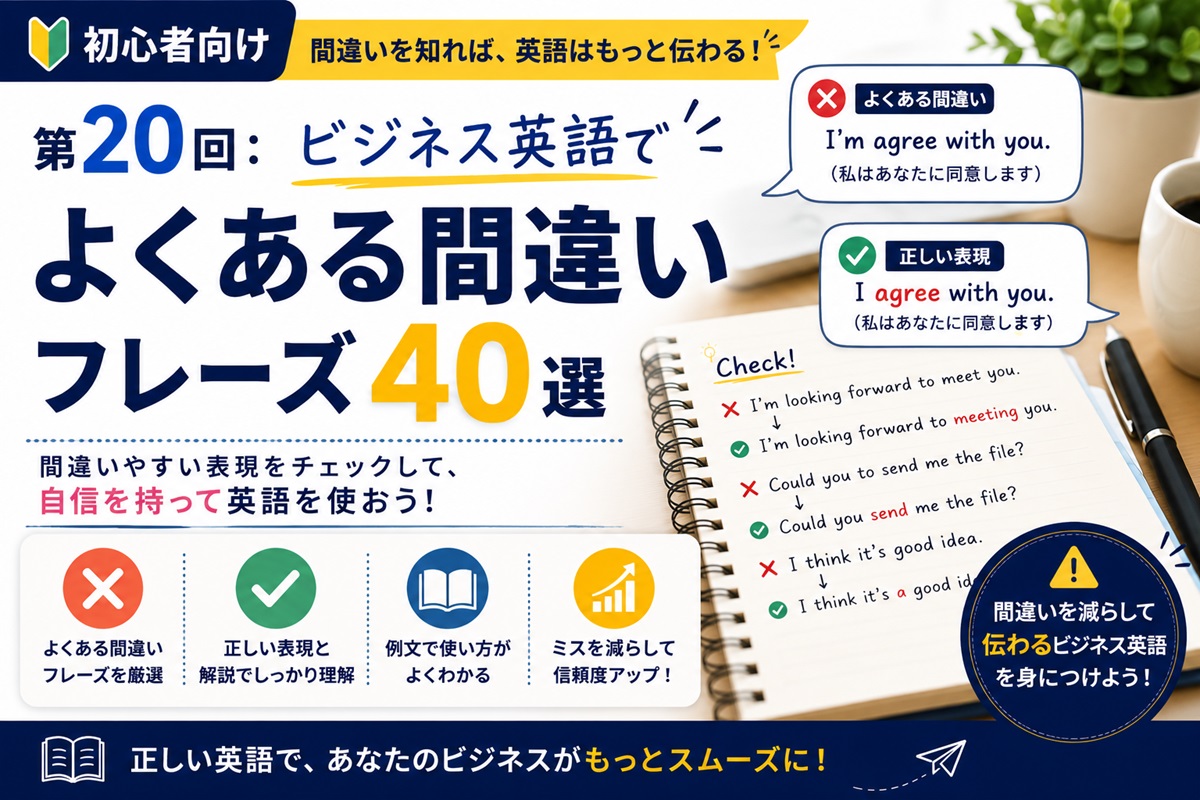
- 第20回:ビジネス英語でよくある間違いフレーズ40選(この記事)
ビジネス英語を勉強していると、「文法的には間違っていないはずなのに、なぜか自然に聞こえない」ということがあります。
特に日本人が英語を使うときは、日本語をそのまま英語に直訳したり、学校で覚えた表現をそのまま使ったりすることで、不自然な英語になってしまうことがあります。
たとえば、「よろしくお願いします」をそのまま英語にしようとして困った経験はないでしょうか。
また、「I am interesting.」と「I am interested.」のように、単語を知っていても使い方を間違えやすい表現もあります。
ビジネスの場面では、ちょっとした表現の違いが相手への印象につながることもあります。
そこで今回は、ビジネス英語で初心者が間違えやすいフレーズを40個紹介します。
「間違いやすい表現 → 自然な表現」という形で比較しながら、なぜ間違えやすいのかも簡単に解説します。
ビジネス英語で間違えやすい基本フレーズ
まずは、日常会話でも仕事でも使う機会が多い基本的な表現から見ていきましょう。
1.× I am interesting. → ○ I am interested.
× I am interesting in this project.
私はこのプロジェクトに興味深い人です。
○ I am interested in this project.
私はこのプロジェクトに興味があります。
「interesting」は「興味深い」という意味で、人や物が「興味を持たせる」というニュアンスです。
自分が「興味を持っている」と言いたい場合は「interested」を使います。
2.× I am boring. → ○ I am bored.
× I am boring with this meeting.
私はこの会議を退屈させています。
○ I am bored with this meeting.
私はこの会議に退屈しています。
「boring」は「退屈させるもの」、「bored」は「退屈している人」の状態を表します。
「interesting / interested」と同じような使い分けです。
3.× I have a business trip tomorrow. → ○ I’m going on a business trip tomorrow.
× I have a business trip tomorrow.
明日、出張があります。
○ I’m going on a business trip tomorrow.
明日、出張に行きます。
「have a business trip」でも意味は伝わりますが、「出張に行く」と表現するなら「go on a business trip」が自然です。
4.× Please teach me. → ○ Please let me know.
× Please teach me the details.
詳細を教えてください。
○ Please let me know the details.
詳細をお知らせください。
日本語の「教えてください」は、英語では必ずしも「teach」を使いません。
「teach」は知識や技能を教える場合に使います。
情報を知らせてもらいたい場合は「let me know」が自然です。
5.× Let’s meeting tomorrow. → ○ Let’s meet tomorrow.
× Let’s meeting tomorrow.
明日会いましょう。
○ Let’s meet tomorrow.
明日会いましょう。
「Let’s」の後ろには動詞の原形を置きます。
そのため、「Let’s meeting」ではなく「Let’s meet」です。
「Let’s go」「Let’s talk」「Let’s discuss」のように使います。
6.× I will contact to you. → ○ I will contact you.
× I will contact to you tomorrow.
明日あなたに連絡します。
○ I will contact you tomorrow.
明日あなたに連絡します。
「contact」は他動詞なので、基本的に「contact + 人」という形になります。
「contact to you」としないように注意しましょう。
7.× I will explain you. → ○ I will explain it to you.
× I will explain you the situation.
あなたに状況を説明します。
○ I will explain the situation to you.
あなたに状況を説明します。
「explain」の後ろに直接「人」を置かないことがポイントです。
「explain + 内容 + to + 人」という形を覚えておきましょう。
8.× Please confirm me. → ○ Please confirm it.
× Please confirm me the schedule.
私にスケジュールを確認してください。
○ Please confirm the schedule.
スケジュールを確認してください。
「confirm」は「確認する」という意味で、基本的に「confirm + 内容」と使います。
「私に確認してください」という意味なら、「Please confirm it with me.」などの表現を使います。
9.× I agree your opinion. → ○ I agree with your opinion.
× I agree your opinion.
あなたの意見に賛成です。
○ I agree with your opinion.
あなたの意見に賛成です。
「agree」は「agree with ~」の形で使うことが多い表現です。
「agree your opinion」としないように注意しましょう。
10.× discuss about the problem → ○ discuss the problem
× We need to discuss about this issue.
この問題について話し合う必要があります。
○ We need to discuss this issue.
この問題について話し合う必要があります。
「discuss」自体に「~について話し合う」という意味があるため、通常「about」は必要ありません。
「discuss the issue」のように使います。
前置詞や単語の使い方で間違えやすい表現
英語では、単語そのものは知っていても、後ろに置く前置詞を間違えてしまうことがあります。
特に「contact」「reply」「agree」「attend」などは、セットで覚えておくと間違いを減らせます。
11.× return back → ○ return
× I will return back to the office.
オフィスに戻ります。
○ I will return to the office.
オフィスに戻ります。
「return」にはすでに「戻る」という意味が含まれているため、「back」を重ねなくても意味が通じます。
会話では「go back」もよく使います。
12.× repeat again → ○ repeat
× Could you repeat that again?
もう一度繰り返していただけますか?
○ Could you repeat that?
もう一度言っていただけますか?
「repeat」自体に「もう一度言う・繰り返す」という意味があります。
ただし、実際の会話では「repeat that again」も使われるため、絶対的な文法ミスというわけではありません。
13.× Please reply back. → ○ Please reply.
× Please reply back to my email.
メールに返信してください。
○ Please reply to my email.
メールに返信してください。
「reply」には「返信する」という意味があるため、基本的には「back」は必要ありません。
「reply to ~」という形で覚えましょう。
14.× I want your answer. → ○ I would appreciate your response.
× I want your answer as soon as possible.
できるだけ早く返事が欲しいです。
○ I would appreciate your response as soon as possible.
できるだけ早くご返信いただけると幸いです。
「I want ~」は直接的な印象になりやすい表現です。
ビジネスでは「I would appreciate ~」などを使うことで、より丁寧に依頼できます。
15.× Let’s do a meeting. → ○ Let’s have a meeting.
× Let’s do a meeting tomorrow.
明日会議をしましょう。
○ Let’s have a meeting tomorrow.
明日会議をしましょう。
日本語では「会議をする」と言いますが、英語では「have a meeting」が一般的です。
「have a meeting」は仕事で非常によく使う表現なので、セットで覚えておきましょう。
16.× I did a mistake. → ○ I made a mistake.
× I did a mistake.
ミスをしました。
○ I made a mistake.
ミスをしました。
「mistake」には通常「make」を使います。
「make a mistake」で「間違える」「ミスをする」という意味になります。
17.× I did my best efforts. → ○ I made every effort.
× I did my best efforts to finish the project.
プロジェクトを終えるために最大限努力しました。
○ I made every effort to finish the project.
プロジェクトを終えるためにあらゆる努力をしました。
「do one’s best」と「make an effort」はそれぞれ自然な表現です。
「do my best efforts」と混ぜないようにしましょう。
「I did my best.」や「I made every effort.」とするのが自然です。
18.× Please take care about yourself. → ○ Please take care of yourself.
× Please take care about yourself.
体に気をつけてください。
○ Please take care of yourself.
お体に気をつけてください。
「take care of ~」で「~を大切にする」「~の世話をする」という意味になります。
自分の体に気をつけてほしいと伝える場合は「take care of yourself」です。
19.× I’m looking forward to meet you. → ○ I’m looking forward to meeting you.
× I’m looking forward to meet you.
お会いするのを楽しみにしています。
○ I’m looking forward to meeting you.
お会いするのを楽しみにしています。
「look forward to」の「to」は前置詞なので、その後ろには名詞や動名詞が来ます。
そのため、「to meet」ではなく「to meeting」とします。
20.× Thank you for your corporation. → ○ Thank you for your cooperation.
× Thank you for your corporation.
ご協力ありがとうございます。
○ Thank you for your cooperation.
ご協力ありがとうございます。
「cooperation」は「協力」、「corporation」は「企業・法人」という意味です。
スペルが似ているため、メールなどで間違えないように注意しましょう。
ビジネスメールで間違えやすい表現
メールでは、普段の会話とは少し違った定型表現を使うことがあります。
日本語をそのまま英語にすると不自然になりやすい表現も多いので、よく使う形をそのまま覚えておくと便利です。
21.× I have a question to you. → ○ I have a question for you.
× I have a question to you.
あなたに質問があります。
○ I have a question for you.
あなたに質問があります。
「question for you」で「あなたへの質問」という形になります。
22.× Please advise me your opinion. → ○ Please let me know your opinion.
× Please advise me your opinion.
あなたの意見を教えてください。
○ Please let me know your opinion.
あなたの意見を教えてください。
「advise」は「助言する」という意味の動詞です。
単純に「意見を教えてください」と言いたい場合は、「Please let me know your opinion.」が分かりやすい表現です。
23.× I will send you an attached file. → ○ I will send you the attached file.
× I will send you an attached file.
添付ファイルを送ります。
○ I will send you the attached file.
添付ファイルを送ります。
すでに特定の添付ファイルについて話しているなら、「the attached file」とするのが自然です。
メールでは「Please find the attached file.」などの表現もよく使われます。
24.× Please see the below file. → ○ Please see the file below.
× Please see the below file.
下記のファイルをご確認ください。
○ Please see the file below.
下記のファイルをご確認ください。
「below」は「the file below」のように、後ろから名詞を修飾する形が自然です。
「the below file」も使われることがありますが、初心者は「the file below」と覚えると分かりやすいでしょう。
25.× We discussed about it. → ○ We discussed it.
× We discussed about the new plan.
新しい計画について話し合いました。
○ We discussed the new plan.
新しい計画について話し合いました。
「discuss」は「about」を必要としない代表的な動詞です。
「discuss + 内容」という形で使いましょう。
26.× Please consider about it. → ○ Please consider it.
× Please consider about my proposal.
私の提案を検討してください。
○ Please consider my proposal.
私の提案を検討してください。
「consider」も「~について検討する」という意味で使えるため、通常「about」は不要です。
「consider the proposal」のように使います。
27.× I have to attend to the meeting. → ○ I have to attend the meeting.
× I have to attend to the meeting.
会議に出席しなければなりません。
○ I have to attend the meeting.
会議に出席しなければなりません。
「attend」は「出席する」という意味では他動詞なので、「attend the meeting」とします。
「attend to ~」になると「~に対処する」という別の意味になります。
28.× I entered into the room. → ○ I entered the room.
× I entered into the room.
部屋に入りました。
○ I entered the room.
部屋に入りました。
「enter」には「入る」という意味があるため、「enter the room」のように場所を直接続けることができます。
29.× I will call to you later. → ○ I will call you later.
× I will call to you later.
後で電話します。
○ I will call you later.
後で電話します。
人に電話をする場合は「call + 人」という形で使います。
「call to ~」は「~に向かって呼びかける」という別の意味になることがあります。
30.× We need to discuss the matter with each other. → ○ We need to discuss the matter.
× We need to discuss the matter with each other.
私たちはお互いにその問題について話し合う必要があります。
○ We need to discuss the matter.
その問題について話し合う必要があります。
「discuss」には複数の人が話し合うという意味が含まれているため、「with each other」は必ずしも必要ではありません。
もちろん、文脈によって付けても間違いではありません。
時間・予定・仕事に関する間違いやすい表現
日付や予定を英語で伝えるときにも、日本語の感覚から前置詞を付けてしまうことがあります。
特に「next week」「Monday」などは、前置詞の使い分けに注意しましょう。
31.× I will make a reservation of the hotel. → ○ I will make a hotel reservation.
× I will make a reservation of the hotel.
ホテルを予約します。
○ I will make a hotel reservation.
ホテルを予約します。
「make a reservation」で「予約する」という意味です。
「ホテルの予約」と言いたい場合は「make a hotel reservation」とすると自然です。
32.× I am in charge for this project. → ○ I am in charge of this project.
× I am in charge for this project.
このプロジェクトを担当しています。
○ I am in charge of this project.
このプロジェクトを担当しています。
「in charge of ~」で「~を担当している」という意味です。
「of」を使うことをセットで覚えておきましょう。
33.× We are planning to do it on next week. → ○ We are planning to do it next week.
× We are planning to do it on next week.
来週それをする予定です。
○ We are planning to do it next week.
来週それをする予定です。
「next week」「next month」「next year」などの前には、通常「on」を付けません。
一方、「on Monday」のように具体的な曜日には「on」を使います。
34.× We will have a meeting in Monday. → ○ We will have a meeting on Monday.
× We will have a meeting in Monday.
月曜日に会議があります。
○ We will have a meeting on Monday.
月曜日に会議があります。
曜日には「on」を使います。
「on Monday」「on Friday」のように覚えておきましょう。
35.× We will discuss it at next meeting. → ○ We will discuss it at the next meeting.
× We will discuss it at next meeting.
次の会議でそれについて話し合います。
○ We will discuss it at the next meeting.
次の会議でそれについて話し合います。
特定の「次の会議」を指している場合は、「the next meeting」とするのが自然です。
仕事でよく使う動詞の間違い
最後に、仕事で頻繁に登場する「reply」「contact」「hope」などの表現を確認しましょう。
36.× I look forward to hear from you. → ○ I look forward to hearing from you.
× I look forward to hear from you.
ご返信をお待ちしております。
○ I look forward to hearing from you.
ご返信をお待ちしております。
「look forward to」の「to」は前置詞なので、「hear」ではなく「hearing」にします。
英文メールの締めとして非常によく使われる表現です。
37.× We will reply you soon. → ○ We will reply to you soon.
× We will reply you soon.
すぐに返信します。
○ We will reply to you soon.
すぐに返信します。
「reply」は「reply to + 人・メール」の形で使います。
一方、「answer」は「answer + 質問」のように直接目的語を取ることができます。
38.× Please contact with me. → ○ Please contact me.
× Please contact with me if you have any questions.
質問があれば私に連絡してください。
○ Please contact me if you have any questions.
質問があれば私にご連絡ください。
「contact」は「contact + 人」と使うので、通常「with」は必要ありません。
「get in touch with me」と言う場合は「with」を使います。
39.× I hope you can understand. → ○ I hope you understand.
× I hope you can understand the situation.
この状況を理解していただければと思います。
○ I hope you understand the situation.
この状況をご理解いただければと思います。
「I hope you can understand」も文法的に使えますが、「理解してもらえることを願う」という意味では「I hope you understand」が自然です。
40.× Please give me your support. → ○ Thank you for your support.
× Please give me your support.
ご支援をお願いします。
○ Thank you for your support.
ご支援ありがとうございます。
「give me your support」は意味としては通じますが、日本語の「ご支援よろしくお願いします」をそのまま英語にすると不自然になりやすい例です。
すでに支援を受けている場合は「Thank you for your support.」が自然です。
まだ協力をお願いしている段階なら、「We appreciate your support.」なども使えます。
ビジネス英語の間違いを減らす3つのポイント
ここまで、初心者が間違えやすい40個の表現を紹介しました。
英語のミスを減らすためには、単語を一つずつ覚えるだけではなく、「どの単語と一緒に使うのか」をセットで覚えることが大切です。
1.動詞と前置詞をセットで覚える
英語では、動詞によって一緒に使う前置詞が決まっていることがあります。
たとえば、
contact + 人
reply to + 人
agree with + 人・意見
in charge of + 名詞
look forward to + 動名詞
のように、単語単体ではなく「かたまり」で覚えると間違いが減ります。
2.日本語をそのまま英語にしない
英語の間違いの中には、日本語を一語ずつ英語に置き換えることで起こるものがあります。
「会議をする」→ do a meeting
と考えるのではなく、
「会議をする」→ have a meeting
と、英語ではどのように表現するのかを覚えることが大切です。
同じように、日本語独特の表現も、状況に応じて英語では別の表現に置き換える必要があります。
3.正しい表現を丸ごと覚える
「look forward to」の後ろが「to + 動詞」だから……と毎回文法を考えていると、実際の会話ではなかなかスムーズに出てきません。
I look forward to hearing from you.
という一つのフレーズとして覚えてしまうのもおすすめです。
英語では、このような定型表現を「かたまり」で覚えることで、会話やメールで使いやすくなります。
特に覚えておきたい間違いやすい表現
今回紹介した40個の中でも、仕事で特に使う機会が多いものをまとめておきましょう。
× I will contact to you.
○ I will contact you.
× I will explain you.
○ I will explain it to you.
× I agree your opinion.
○ I agree with your opinion.
× We discussed about it.
○ We discussed it.
× I did a mistake.
○ I made a mistake.
× I’m looking forward to meet you.
○ I’m looking forward to meeting you.
× I am in charge for this project.
○ I am in charge of this project.
× We will reply you soon.
○ We will reply to you soon.
× Please contact with me.
○ Please contact me.
× I am interesting in this project.
○ I am interested in this project.
これらは単語を一つずつ覚えるよりも、「正しい組み合わせ」で覚えるのがおすすめです。
まとめ
今回は、ビジネス英語で初心者が間違えやすいフレーズを40個紹介しました。
英語では、一つの単語を覚えるだけではなく、「どの単語と組み合わせるのか」「前置詞は必要なのか」「後ろには名詞と動詞のどちらが来るのか」まで意識すると、表現の正確さが大きく向上します。
特に、
contact + 人
reply to + 人
agree with + 人・意見
in charge of + 名詞
look forward to + 動名詞
のような組み合わせは、仕事でも使う機会が多いため、セットで覚えておきましょう。
また、日本語をそのまま英語に直訳しないことも重要です。
「会議をする」を「do a meeting」とするのではなく、「have a meeting」と覚えるように、英語では実際にどのような表現を使うのかをそのまま覚えていくと、自然な英語に近づいていきます。
最初から40個すべてを完璧に覚える必要はありません。
まずは自分が仕事でよく使う表現から5~10個選び、正しい形を繰り返し練習してみましょう。
「通じればOK」で終わらせず、「より自然で正確な英語」を少しずつ身につけていくことが、ビジネス英語の上達につながります。
オンライン英会話で実際に話す練習もしてみよう
ビジネス英語のフレーズを覚えるだけでなく、実際に英語を話す練習をしたい方は、オンライン英会話を活用するのもおすすめです。
初心者向けのオンライン英会話を、料金や特徴、向いている人別に比較しています。
関連記事
- ビジネス英語フレーズ40選シリーズ|初心者向け完全ガイド【第1回~第25回】
- 初心者向けビジネス英語⑮|海外出張で使えるビジネス英語フレーズ40選
- 初心者向けビジネス英語⑯|英文メールでよく使う締めのフレーズ40選
- 初心者向けビジネス英語⑰|丁寧に伝えるビジネス英語フレーズ40選
- 初心者向けビジネス英語⑱|英語で雑談・スモールトークするときのフレーズ40選
- 初心者向けビジネス英語⑲|ビジネス英語の言い換えフレーズ40選
- 初心者向けビジネス英語㉑|ビジネス英語の相づち・リアクション表現40選
参考サイト(外部リンク)
- BBC Learning English(無料でビジネス英語や文法を学べます。)
- Cambridge Dictionary(英単語の意味・発音・例文を確認できます。)
- Merriam-Webster Dictionary(アメリカ英語の辞書として定番です。)
- British Council LearnEnglish(無料教材や練習問題が充実しています。)